Escaping the Always-On Trap: Boundaries That Actually Work

On stage at Accountex Manchester last week, I asked a room full of leaders to put their hand up if they’d checked their emails at lunch that day. Nearly every hand went up. Then I asked who’d taken a work call, or had a laptop open, at some point that wasn’t technically work time. Same result. A room full of people who’d booked out of the office for the day, and work had followed them in anyway. Nobody looked surprised.
That’s the always-on trap. Not one big collapse. A thousand small moments where the phone wins and you don’t even notice you’ve chosen it.
If you’re a senior leader in professional or financial services, you’ll know this one well. Deadlines, billable hours, the quiet expectation that you’re reachable whenever anyone needs you. Everyone around you looks like they’re coping. Underneath, decisions slow down, patience runs thin, and the work that actually needs your full attention gets pushed to ten at night, when you’ve got nothing left to give it.
You’ll tell yourself it’s a workload problem, a time problem, and too many things pulling you in too many directions at once. Fair enough. But the workload isn’t going anywhere, and what can change is how much of it you’re carrying that was never yours to carry in the first place.
That’s where boundaries come in, and most advice on this fails leaders like you completely.
Why “just say no” doesn’t work
Somewhere along the way, boundaries got reduced to one piece of advice – ‘Learn to say no’. It’s everywhere and it’s also useless for anyone running a team, because you can’t say no to your job.
You can’t say no to the client who needs an answer. You can’t say no to the report that’s due. You can’t say no to being the person your team looks to when something goes wrong. “Just say no” treats a boundary like a wall and if you build it high enough, the problems stop getting in.
That’s not what a good boundary does.
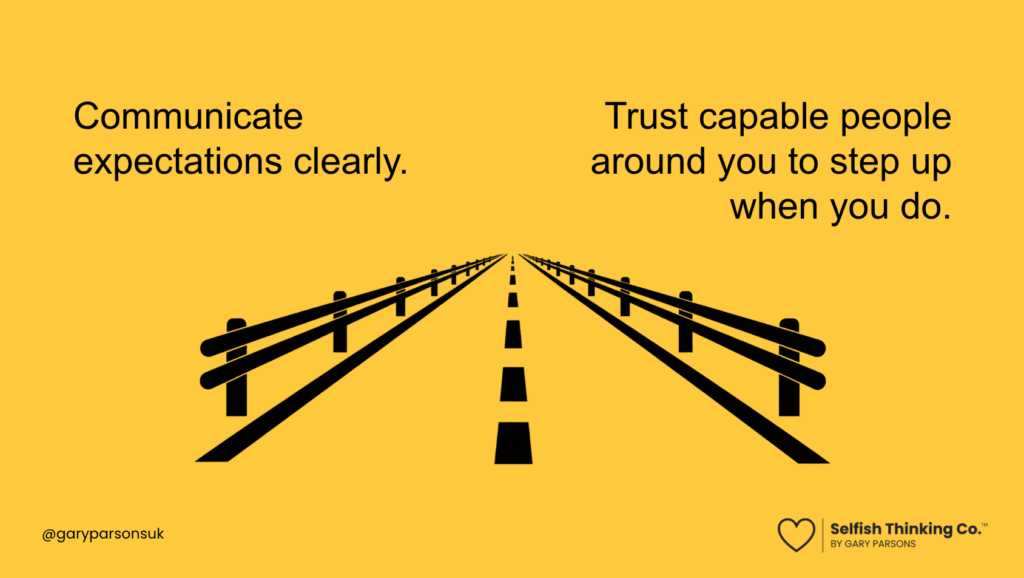
Think about the metal railings on either side of a motorway. You’re not meant to drive into them, but if you hit one, its job isn’t meant to bring you to a stop. It’s meant to bounce you back back on track and keeps you from something genuinely dangerous.
A boundary should do two things. 1) It should tell people clearly what they can expect from you, and 2) it should trust the capable people around you to step up when you’re not the one solving it.
That second part is where most leaders fall down. Not through lack of discipline. Because they’ve built a team that’s never had the chance to prove it can manage without them.
The word, and the guilt attached to it
Most people’s first reaction to the word “selfish” is negative. We see it as greedy, arrogant, or self-centred. That’s fine; it used to be mine too, most of the time.
The guilt is the problem, not the word. Protecting your own capacity isn’t indulgence. It’s what lets you make better calls, more consistently, when the pressure’s actually on. This isn’t a wellbeing conversation, it’s a performance one.
Research I’ve run with East Midlands leaders backs this up. Three-quarters said their wellbeing affects the quality of their decisions, and fewer than one in twenty actively prioritise it. That gap is where the always-on trap lives, and it’s costing businesses more than most realise.
Three Guardrails that actually work
So here are three guardrails I’ve used, tested, and got badly wrong before I got right. Pick one.
1) The Escalation Guardrail
Decide in advance what genuinely needs you and what your team can decide without you.
For years, I was the person every decision came to. Client wants a discount, ask Gary! New starter unsure how to handle something, ask Gary! It felt responsible bu it was actually just me being a bottleneck, and I didn’t notice, because being needed felt like being valuable.
Once I drew a line, anything under a certain threshold, my team decided, not asked, decided, decisions that used to sit in my inbox for two days started happening in ten minutes.
2) The Response-Time Guardrail
Set the expectation before someone else sets it for you.
I ran a payroll bureau with a clear SLA, anything received gets actioned by end of the next working day. One client would email over the weekend, then call Monday expecting it done within the hour, and my team, feeling guilty saying no, would jump on it every time. Without anyone deciding it, we’d trained that client to ignore our actual SLA.
Holding it again, no apology, no new negotiation, just the boundary we already had, fixed the problem in a week.
3) The Recommendation-First Guardrail
Nobody brings you a problem without a proposed answer attached.
I had an apprentice administrator who’d bring me problems and wait, expecting me to solve them. I started asking one question every time, genuinely asking, not catching him out: what do you think we should do?
Within a couple of years he’d become one of the most instrumental people in the business, spotting problems before they became problems. It started with one small change, not solving it for him.

The turning point
I built a business over a decade, multi-award-winning, growing fast, first in, and last out.
In 2017, at what looked like the highest point of visible success, we’d just won an award for the way we developed our people. I was in the photo, developing everyone else. The one person who’d completely disengaged was me.
I was diagnosed with severe depression that year.
That’s when I stopped asking how do I do more, and started asking why am I doing it this way. I stepped down as CEO in 2024 and fully exited the business in 2025. The guardrails above are what I built in the years between, tested on myself before anyone else.
Pick one
You don’t need all three. You need one, held properly, starting this week, and not the easiest one. The one that would actually change your week if you stopped bending on it.
Hold it without apologising for it.
The leaders who protect their time aren’t the selfish ones in the room – they’re the ones who win!
If this landed, it’s the exact ground I cover when I speak with leadership teams in professional services. Book a conversation →

Gary Parsons
https://garyparsons.ukGary Parsons is a Leadership Speakerand Business Mentor on a mission to redefine success in leadership. Drawing on his powerful SELF Framework, Gary helps leaders prioritise their own wellbeing because when leaders thrive, their teams do too. Through his talks, workshops, and mentoring, he equips leaders to set boundaries, elevate wellbeing, and lead with intention - proving that Selfish Leadership isn’t a weakness, it’s a strategy for sustainable growth. Reach out to explore how Gary can help your leaders perform better by putting themselves first, strategically.