Self-Sabotage in Leadership – 5 Ways to Overcome It
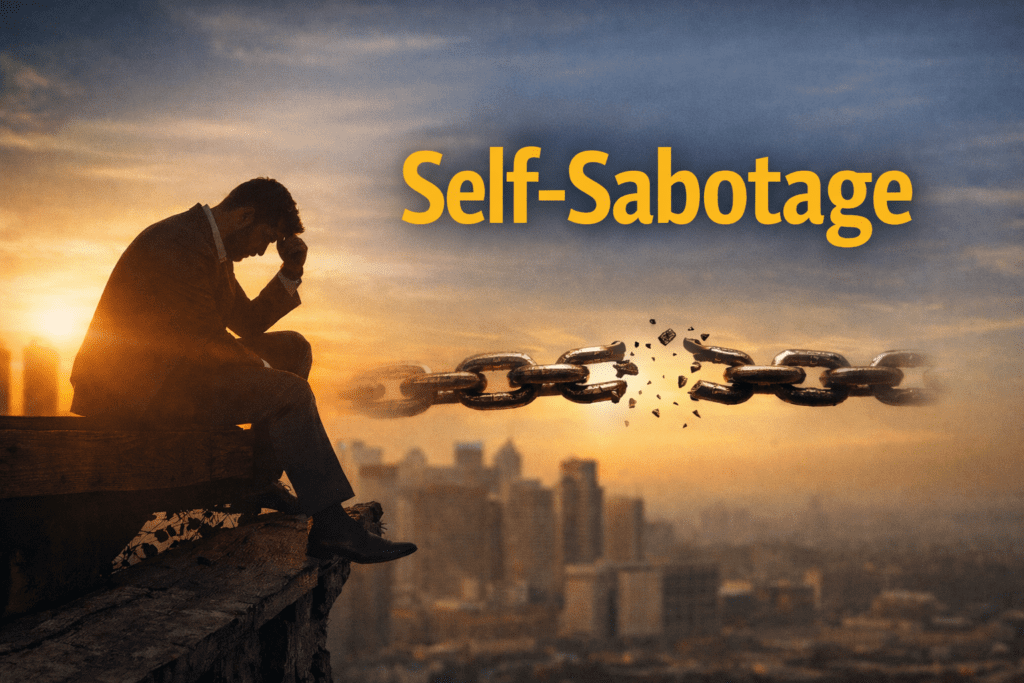
One of the challenges we have as leaders and founders is that people depend on us.
Teams depend on us. Clients depend on us. Sometimes, entire businesses depend on the decisions we make. That responsibility shapes how we think and how we behave, and often it means carrying pressure that most people around us never see.
From the outside, leadership can look confident and decisive. But behind the scenes, many leaders are wrestling with something far less visible. The uncomfortable truth is that one of the biggest obstacles leaders face isn’t competition, market conditions, or funding. Quite often the biggest obstacle is themselves.
I was reminded of this after running an activity at a Professional Speaking Association event. Afterwards, someone emailed me to say the exercise had triggered something for them. It made them realise they might actually be blocking their own progress. They also admitted something many leaders struggle to say out loud, that asking for help feels incredibly difficult. Then they wrote something that really jumped out to me:
“It’s been years that I have ideas, but somehow I always manage to self-sabotage myself.”
If you’ve led a business, built something from scratch, or carried responsibility for others, there’s a good chance that sentence feels familiar.
Because self-sabotage shows up far more often in leadership than people realise.
Why Leaders Self-Sabotage
Psychologists often describe self-sabotage as a protective behaviour. The brain is trying to avoid perceived threat, even when that threat is simply emotional risk, such as judgment, failure, or embarrassment. In psychology, this is sometimes linked to a concept known as self-handicapping, where people unconsciously create obstacles that protect their sense of identity if things don’t go well. For leaders, those threats tend to feel amplified. The bigger the responsibility, the louder the internal voice questioning whether you are ready.
Interestingly, success can trigger this too, because success raises expectations, and raises visibility. It raises the stakes and suddenly the voice in your head starts whispering things like maybe you should wait a little longer, maybe the idea isn’t ready yet. It may sound logical but often feels responsible. But sometimes it’s simply fear wearing the disguise of strategy.
Leadership can also be isolating. Research frequently highlights that many CEOs report feelings of loneliness in their role, something that can amplify hesitation and self-doubt. When you’re the person everyone else relies on, it can feel difficult to show uncertainty or ask for help. Over time that isolation creates a pattern I often see with founders and leaders.
I call it the leadership hesitation loop.
It usually looks something like this:
Idea → Doubt → Delay → Frustration → Repeat.
Nothing catastrophic happens. The idea just never quite moves forward.
5 Ways Leaders Can Tackle Self-Sabotage

Breaking the cycle doesn’t require dramatic change. In most cases it starts with small shifts in awareness and behaviour.
– 1. Recognise When You’re Blocking Yourself
Many leaders assume every thought in their head is rational, but often those thoughts are simply avoidance disguised as logic.
When you catch yourself hesitating, it helps to pause and ask a simple question:
- Is this a genuine strategic decision, or am I avoiding discomfort?
That moment of honesty can be surprisingly revealing. Awareness is usually the first step in breaking the pattern.
– 2. Make the First Step Smaller
Leaders often sabotage themselves because the action feels too big.
Launch the new venture, write the book, or change direction in the business.
The brain immediately sees risk everywhere. Instead, shrink the move. Share the idea with one trusted person. Write the first page. Test the concept with a handful of customers.
Momentum rarely begins with bold leaps. It usually starts with small acts of courage repeated consistently.
– 3. Break the Isolation Loop
Leadership can be incredibly isolating. Many founders feel they must always appear confident and capable, which means doubts and fears stay locked inside their own heads.
We’ve learn over time that isolation amplifies self-doubt.
The moment you talk openly with someone you trust, something shifts. Perspective appears. A mentor, peer, or advisor can often see possibilities that are invisible when you’re stuck inside your own thinking.
No successful leader builds anything meaningful completely alone.
– 4. Watch Out for the Perfection Trap
Perfectionism is one of the most socially acceptable forms of self-sabotage.
It looks responsible and sounds professional, but in reality, it is often just fear of judgment.
Leaders who make real progress tend to adopt a different mindset.
Done beats perfect!
Most breakthroughs come from iteration, not waiting until everything feels flawless.
– 5. Separate Your Identity From the Outcome
Many founders attach their identity to their ideas. When an idea doesn’t work, it can feel personal, which creates hesitation and fear of action.
A healthier way to think about it is this.
Ideas are experiments, strategies evolve, and businesses constantly adapt.
Your role as a leader isn’t to always be right; it’s to keep learning faster than the obstacles appear.

The Moment Leaders Realise They Are Their Own Blocker
The email I received after that event ended with a simple reflection… “Maybe it’s time to change that”.
That moment of awareness is often where progress begins. Because once you recognise how you might be getting in your own way, you have a choice.
You can keep repeating the same pattern, or you can decide that the ideas you’ve been sitting on deserve the chance to exist beyond your own doubts.
Many leaders assume the biggest barriers to success will be external. Competition, funding, the economy, the market. But sometimes the real barrier is quieter. It’s the voice in your own head telling you to wait just a little longer. And sometimes the most powerful step a leader can take is simply deciding to move forward anyway.

Gary Parsons
https://garyparsons.ukGary Parsons is a Leadership Speakerand Business Mentor on a mission to redefine success in leadership. Drawing on his powerful SELF Framework, Gary helps leaders prioritise their own wellbeing because when leaders thrive, their teams do too. Through his talks, workshops, and mentoring, he equips leaders to set boundaries, elevate wellbeing, and lead with intention - proving that Selfish Leadership isn’t a weakness, it’s a strategy for sustainable growth. Reach out to explore how Gary can help your leaders perform better by putting themselves first, strategically.