Leadership Has Seasons & Why a Hibernation Mindset Matters

Have you ever noticed that we’re surrounded by language that assumes leadership is linear? If you slow down, something must be wrong.
“Grow, scale, push, accelerate, repeat.”
I’m a believer that real leadership doesn’t work like a straight line. It works more like the natural world, moves in seasons, and one of those seasons is winter. It’s not a season of stopping, but a season of working differently.
The myth of constant growth
Much of modern leadership thinking borrows from the idea of a growth mindset, the belief that ability develops through effort, learning, and persistence. That idea is useful; it reminds us we’re not fixed or limited.
The problem is what often gets lost in translation? Growth mindset quietly turns into permanent exertion, as if effort is always available, as if energy, clarity, and resilience are infinite resources. They aren’t.
Leaders don’t burn out because they don’t believe in growth; they burn out because they believe growth should never pause or change shape.
Leadership has seasons, whether you like it or not
In nature, growth happens in cycles.
- Spring is for learning and planting ideas
- Summer is for momentum and outward energy
- Autumn is for refinement and letting go
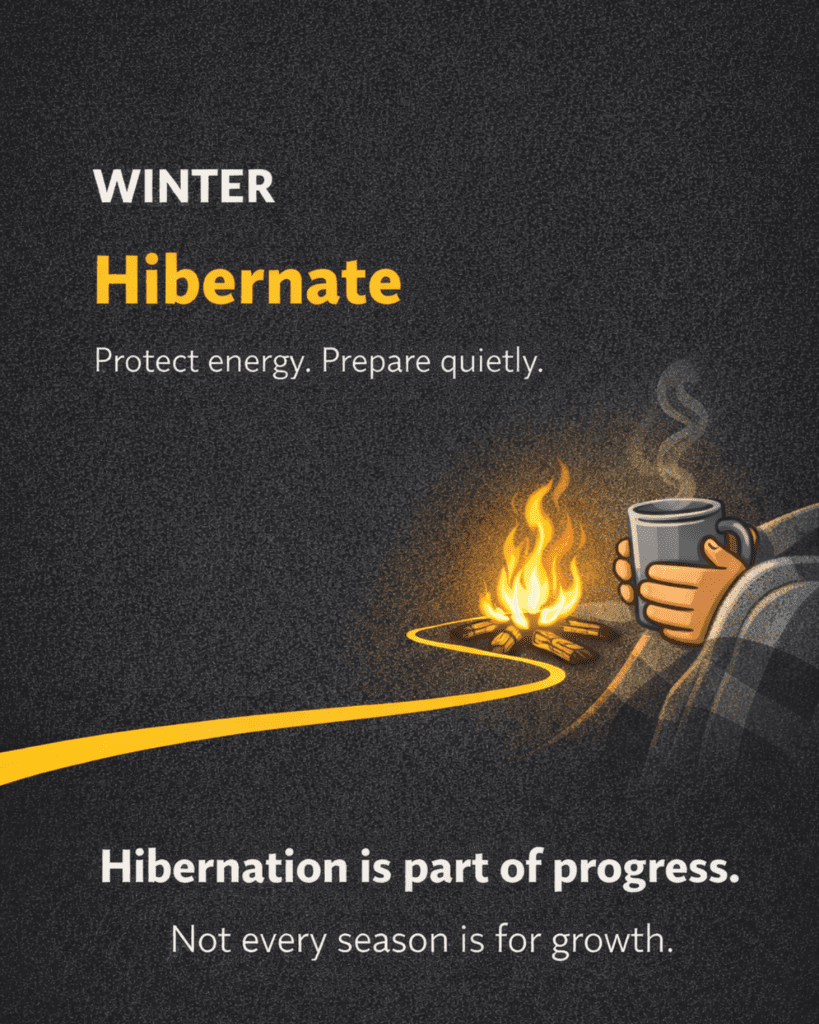
- Winter is for stabilising, preparing, and protecting capacity
Leadership follows the same rhythm, even if we try to ignore it.
Winter often shows up as reduced motivation, slower thinking, decision fatigue, or a growing sense that pushing harder is making things worse, not better. This isn’t failure, it’s feedback.
What a hibernation mindset really is
A hibernation mindset isn’t about hiding, withdrawing, or doing nothing. It’s about deliberate conservation and intentional effort. It’s choosing work that builds foundations rather than drains capacity. Less noise, fewer decisions, and more focus on what actually matters.
In leadership terms, a hibernation mindset often looks like:
- Reducing unnecessary output or performative visibility
- Pausing growth targets that no longer make sense
- Making fewer, better decisions
- Protecting energy, health, and thinking time
- Doing the quiet work that prepares you for the next season
This isn’t laziness, it’s restraint, and restraint is a leadership skill.
Blue Monday, Time to Talk Day, and the reality of winter leadership
Around this time of year, conversations about mental health increase. Blue Monday, often labelled the most depressing day of the year, and Time to Talk Day both surface important themes, but the issue isn’t a single day.
For many leaders, winter is already a quieter, heavier season. Motivation dips, pressure builds, and the expectation to keep performing at full pace doesn’t disappear just because it’s January or February.
A hibernation mindset gives leaders permission to acknowledge this without judgement. It reframes winter not as something to push through, but something to work with.
Time to Talk Day matters because leaders rarely talk about their own capacity. Blue Monday resonates because it reflects something people already feel, and neither should be about fixing yourself. Both should be about understanding the season you’re in and responding intelligently.
Reactive hibernation vs strategic hibernation
Not all slowing down is the same.
- Reactive hibernation comes from overwhelm and fear: It’s unplanned, guilt-ridden, and often accompanied by shame.
- Strategic hibernation is chosen: It’s intentional. It recognises that capacity is a leadership asset worth protecting.
One avoids responsibility and the other protects leadership capability. Leaders who understand the difference stop judging themselves for needing winter and start using it wisely.
Why this matters for Selfish Leadership
Selfish Leadership isn’t about doing less forever, it’s about doing what sustains you long enough to lead well. Ignoring winter doesn’t make it go away and just makes spring weaker when it arrives.
When leaders refuse to adapt their pace, they don’t become heroic. They become brittle, decision-making suffers, relationships strain, creativity dries up, and eventually something breaks.
Prioritising yourself during winter isn’t indulgent, it’s maintenance, and maintenance is what keeps leadership functional.
Growth doesn’t disappear in winter, it goes underground
Honestly, most leadership models skip this. Winter is where the real work happens, not loud work, but important work! This is where thinking deepens, values get clarified, boundaries reset, and future growth gets designed rather than forced. Nothing looks dramatic from the outside, and that’s the point.
Nature doesn’t apologise for winter, it trusts spring will come when the conditions are right, and leaders who last learn to do the same.

The question leaders need to ask
Growth mindset asks whether you can improve if you try harder. A hibernation mindset asks something more honest…
Is now the season to push, or the season to prepare?
Answering that question well is one of the most selfish and most strategic leadership skills there is.

Gary Parsons
https://garyparsons.ukGary Parsons is a Leadership Speakerand Business Mentor on a mission to redefine success in leadership. Drawing on his powerful SELF Framework, Gary helps leaders prioritise their own wellbeing because when leaders thrive, their teams do too. Through his talks, workshops, and mentoring, he equips leaders to set boundaries, elevate wellbeing, and lead with intention - proving that Selfish Leadership isn’t a weakness, it’s a strategy for sustainable growth. Reach out to explore how Gary can help your leaders perform better by putting themselves first, strategically.